You need to pick the right oxygen mask for your patient. Think about how much oxygen they need. Also, think about how exact the oxygen therapy must be. The clinical situation is important too. Forlong Medical gives you both venturi mask and high flow choices. This means you always get good respiratory care products. Sometimes, like after thoracic surgery, high flow oxygen masks help more. They give better oxygen and lower problems. For patients with weak immune systems, both masks work about the same. They both give comfort and good breathing support.
Patient Population | Treatment Comparison | Key Outcomes |
Thoracic surgery patients | HFNC vs Venturi | HFNC gave better oxygen and fewer problems. |
Immunocompromised patients | HFNC vs Venturi | Both masks gave similar comfort and breathing help. |
Key Takeaways
Oxygen Mask Comparison Table
Venturi Mask vs High Flow Oxygen Mask
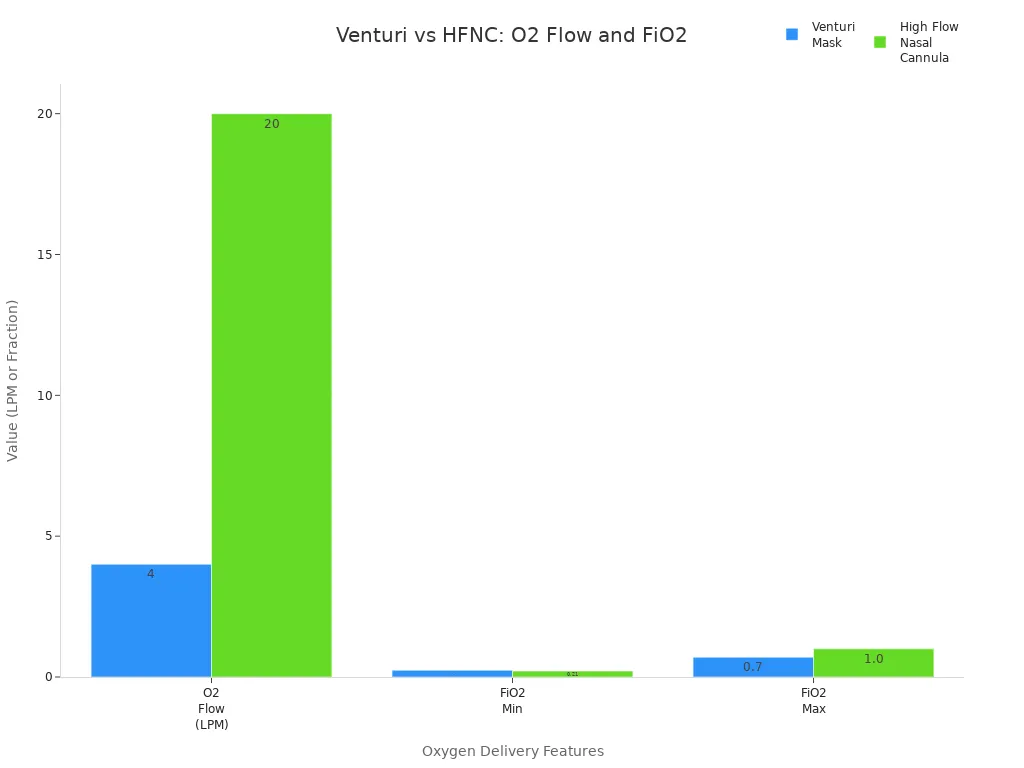
Picking the right oxygen mask is important for patients. You should check how each mask works. Look at how much oxygen each mask gives. Think about which patients need each mask. The table below shows a simple comparison. It compares the venturi mask and high-flow nasal cannula. This table helps you choose the best mask for your patient.
Feature | Venturi Mask | High Flow Nasal Cannula (HFNC) |
O2 Flows | 4-12 LPM | 20-70 LPM |
FiO2 | 0.24-0.7 | 0.21-1.0 |
Patient Population | Adults, some pediatric use | All ages, with proper sizing |
Oxygen Delivery | Precise, fixed | Adjustable, high flow |
Humidification | Not included | Heated, active |
Advantages | Accurate FiO2, ideal for COPD | High FiO2, humidified, some positive pressure |
Limitations | Can interfere with eating/drinking | Needs humidifier, higher cost |
![Bar chart comparing O2 flow rates and FiO2 ranges for Venturi mask and high flow nasal cannula]()
A venturi mask gives very exact oxygen. This is good for people who need careful oxygen therapy, like those with COPD. The venturi mask lets you pick the right oxygen level. This helps stop too much oxygen from being given. If you want more oxygen or need humid air, use the high-flow nasal cannula. It gives many oxygen levels and works for all ages.
Forlong Medical sells both venturi masks and high flow oxygen masks. You can count on their products in any hospital or clinic. Their masks are made with safe materials and always give steady oxygen. If you need a non-rebreather mask for emergencies, Forlong Medical has that too.
When you pick an oxygen mask, think about what the patient needs. Check how much oxygen is needed and if humid air is important. Forlong Medical’s products help you give safe and good oxygen therapy every time.
Key Differences
Delivery Mechanism
You need to know how each device works. The venturi mask uses air-entrainment. It mixes room air with oxygen. This lets you set the oxygen concentration exactly. You pick different colored adaptors for this. This helps you control oxygen therapy. It is important for patients with COPD.
The high-flow nasal cannula gives a high flow of oxygen. It does not mix with room air. You use it for patients who need more oxygen. It also gives comfort. The system heats and adds moisture to the oxygen. This makes it easier for patients to breathe and stops dryness.
Tip: Pick the venturi mask for exact oxygen levels. Choose the high-flow nasal cannula for high flow and comfort.
Feature | Venturi Mask | High Flow Oxygen Mask |
Oxygen Delivery Mechanism | Air-entrainment mixes room air with oxygen for precise concentration | Direct high-flow oxygen delivery without mixing |
Flow Rate | Requires flow rates above minute ventilation | Consistent high flow rate (up to 60 L/min or more) |
FiO2 Control | Adjustable with different adaptors | High FiO2, less precise than venturi mask |
Operational Characteristics | Limited to specific adaptors | Flexible flow rates and oxygen delivery |
FiO2 Precision
You should think about how well each mask gives the right oxygen amount. The venturi mask is very exact. It keeps FiO2 within ±5% of the goal. This works no matter how the patient breathes. You can change the oxygen level fast by switching adaptors. This makes the venturi mask good for patients who need steady oxygen, like those with COPD.
The high-flow nasal cannula gives high FiO2. But it is not as exact as the venturi mask. It gives oxygen well and helps with saturation. But the amount can change if the patient breathes differently. Use the high-flow nasal cannula when you need to give a lot of oxygen and comfort is important.
The venturi mask lets you change settings quickly and gives steady oxygen.
It lowers the risk of germs spreading and is for one patient only.
The high-flow nasal cannula gives high oxygen without a reservoir, but FiO2 control is not as exact.
Flow Rates
You must match the flow rate to what the patient needs. The venturi mask usually works at 4 to 12 L/min. It can give high-flow oxygen if you use the right adaptor. Make sure the flow is higher than the patient’s minute ventilation. This stops rebreathing and keeps the right oxygen level.
The high-flow nasal cannula gives much higher flow rates. It can go up to 60 L/min. This helps give more oxygen and makes breathing easier. It also helps open up the lungs. Use the high-flow nasal cannula for patients with bad breathing problems or who need more oxygen than the venturi mask can give.
Mask Type | Flow Rate (L/min) | FIO2 Range |
Venturi Mask | 4-12 | 0.24-0.7 |
High Flow Nasal Cannula | 50-60 | 0.21-1.0 |
Non-rebreather mask | 10-15 | Highest FiO2 |
High-flow nasal cannula gives warm, wet oxygen.
It can give up to 60 L/min, which helps comfort and oxygen delivery.
Humidification
You need to think about humidification when picking a mask. The venturi mask does not have humidification. Patients may feel dry or uncomfortable if they use it for a long time. You can add a humidifier, but it is not included.
The high-flow nasal cannula always gives heated and wet oxygen. This helps patients feel better and stops dryness. It also helps stop problems like nosebleeds or irritation. Use the high-flow nasal cannula for patients who need oxygen for a long time or who feel dry.
Note: Doctors say you should check the patient often and watch oxygen levels. If the venturi mask cannot keep oxygen above 88%, you should try a high-flow oxygen device.
Venturi Mask: When to Use
Indications
A venturi mask is used when you need exact oxygen control. It works best for patients who need a set amount of oxygen. Doctors often use it for people with chronic obstructive pulmonary disease. The venturi mask helps stop problems from too much oxygen, like keeping too much carbon dioxide. You can use it for asthma patients or those who might get hypercapnia. Forlong Medical has venturi masks that let you pick the right oxygen level.
You need steady oxygen for COPD.
You want to keep oxygen low for sensitive patients.
You help patients with breathing that changes a lot.
Advantages
Venturi masks give steady and accurate oxygen. You can change the oxygen level fast by switching color adaptors. This makes it easy to fit what the patient needs. The venturi mask keeps oxygen steady, even if the patient breathes fast or slow. This is important for critical care. Compared to other masks, the venturi mask gives more control at lower oxygen levels.
Venturi masks are made for exact FiO2 control. They keep oxygen steady no matter how the patient breathes. This helps patients who need exact oxygen therapy do better.
Limitations
The venturi mask can be harder to use than other masks. You must pay attention when setting it up. You need to pick the right adaptor and make sure it fits well. If the mask does not fit, leaks can change how much oxygen the patient gets. Some patients may feel uncomfortable or get skin irritation if they use it for a long time. The mask has many parts, so setup takes longer. Noise from the mask may bother some patients.
Harder to set up and use
Fit and leaks can change how it works
Comfort is different for each patient
Long use may cause skin problems
Ideal Patients
Pick the venturi mask for patients who need steady oxygen. This includes people with COPD, those who might get hypercapnia, and people who need stable oxygen. Asthma patients or those who cannot handle high oxygen also do well with this mask. The venturi mask is good when you want to avoid risks from other masks in sensitive cases.
Patients with COPD
People who need exact oxygen
Those at risk of hypercapnia or hyperoxia
Asthma patients who need steady oxygen
High Flow Oxygen Mask: When to Use
Indications
A high flow oxygen mask is used when a patient needs a lot of oxygen and careful control. This device works in many medical situations. Doctors use it for people with chronic obstructive pulmonary disease. It is also used for patients with acute respiratory distress syndrome. People who are getting better after surgery may need this mask too. The table below shows when you might pick this mask:
Clinical Scenario | Description |
Chronic Obstructive Pulmonary Disease (COPD) | High flow oxygen masks are ideal for COPD patients to maintain oxygen levels without carbon dioxide retention. |
Acute Respiratory Distress Syndrome (ARDS) | ARDS patients require high-flow oxygen therapy to maintain saturation, with careful monitoring of oxygen concentration. |
Post-operative Care | Used in post-anesthesia care to ensure appropriate oxygen levels during recovery from surgery. |
This mask is good for patients who need steady oxygen. It also helps people who do not get better with a non-rebreather mask. Forlong Medical makes strong and safe masks for these needs. Their high flow oxygen masks give steady oxygen and help people with hard breathing problems.
Advantages
There are many good things about using a high flow oxygen mask. This mask gives a lot of oxygen and helps people who have trouble breathing. It also helps remove carbon dioxide from the upper airways. This makes it easier to breathe. The mask gives a little positive pressure. This helps keep the lungs open and working well.
Here are the main advantages:
Helps patients with low blood oxygen.
Removes carbon dioxide for better gas exchange.
Gives gentle pressure to keep airways open.
Makes breathing more comfortable with warm, wet air.
Lowers the need for tubes in the windpipe.
Reduces the chance of getting pneumonia from a ventilator.
Lets patients move and talk more than other masks.
You can trust Forlong Medical’s high flow oxygen masks for these benefits. Their masks are made with safe materials and smart designs. This keeps patients safe and comfortable during oxygen therapy.
Limitations
You should know about some problems with high flow oxygen masks. How well the mask works can change if the patient breathes differently. If the mask does not fit right, the patient might breathe in old air. This can cause problems. Dry oxygen can make the nose and throat hurt if there is no humidification. It can be hard to keep the oxygen level steady if the flow or fit is not right.
The table below lists common limitations:
Limitation | Description |
Variable performance in oxygen delivery | The device's performance can vary based on the patient's inspiratory demands, affecting FiO2 levels. |
Carbon dioxide retention | Poor mask fit can lead to inhalation of exhaled CO₂, causing respiratory issues. |
Discomfort from dry oxygen | High flow oxygen can dehydrate respiratory mucosa, leading to irritation and discomfort. |
Inconsistent FiO2 levels | Achieving stable FiO2 is challenging due to factors like mask fit and flow rates. |
Potential respiratory complications | High flow oxygen therapy can lead to complications if not properly managed. |
Watch for signs like dizziness or confusion, which can mean carbon dioxide is building up. Dryness can cause nosebleeds or a sore throat. Forlong Medical’s masks are made to fit well and feel better. But you should always check your patient often during oxygen therapy.
Ideal Patients
A high flow oxygen mask is best for people who need a lot of oxygen and want to feel comfortable. This includes people with bad breathing problems. It also helps those who need more oxygen than a regular mask gives. People with COPD flare-ups and those healing from lung surgery can use this mask too.
Here are the groups who benefit most:
Patients with bad breathing who need more oxygen and easier breathing.
People with COPD who want comfortable and strong oxygen therapy.
Patients after lung surgery who need steady oxygen.
People who cannot use a non-rebreather mask or need oxygen for a long time.
You can count on Forlong Medical’s masks for these patients. Their high flow oxygen masks help many people and let you give safe and strong oxygen therapy in any hospital or clinic.
Clinical Scenarios & Practical Tips
Case Examples
You will see different oxygen needs in your work. A patient with COPD may need a venturi mask to keep oxygen steady. A patient after surgery may need a high-flow nasal cannula for more comfort and wet air. If someone suddenly has low oxygen, you might use a non-rebreather mask first. Later, you can switch to a more exact device. Forlong Medical has masks and cannulas for these cases. This helps you pick the right product for each patient.
Assessing Needs
You should always check how the patient breathes and feels before picking a device. Watch how fast the patient breathes and how much oxygen they need. If the patient breathes over 30 times a minute with a venturi mask, turn up the flow by half. If the patient still needs more oxygen, or if FiO2 is over 40 percent, think about using a high-flow nasal cannula. Talk to a senior doctor before switching. Forlong Medical’s products let you change quickly when the patient’s needs change.
Monitoring & Switching
You must watch patients closely during oxygen therapy. Follow these steps to keep care safe and helpful:
Watch for comfort and make sure the mask fits well. Look for signs like worry, restlessness, or the mask moving.
Check oxygen levels with pulse oximetry trends, not just one reading.
Check again after moving the patient or changing the mask.
Look at the skin under the mask for redness or sore spots.
Keep the nose and mouth wet, especially if the mask is used for a long time.
Check the device often during your rounds.
Staff training is very important for safe oxygen therapy. The table below shows key training points:
Training Component | Purpose |
Pick the right adapter and FiO₂ | Make sure oxygen is correct |
Set the oxygen flow as told | Keep the right amount of oxygen |
Check ports for blockages | Stop problems with oxygen delivery |
Know when to get more help | Make sure help comes fast |
Write down settings clearly | Stop mistakes when handing over care |
Use scenario checks | Find common problems quickly |
Forlong Medical gives your team easy and safe products for every oxygen therapy need.
You must pick the best device for every patient. Check how much oxygen the patient needs. Think about how exact the FiO2 should be. Use a Venturi mask when you need very exact oxygen. Choose a high flow oxygen mask if the patient needs more comfort or higher oxygen. In emergencies, you might use a non-rebreather mask. Forlong Medical has safe and trusted Respiratory Care products. These products help you give good care to your patients.
FAQ
What is the main difference between a Venturi mask and a high flow oxygen mask?
A Venturi mask gives exact oxygen control. A high flow mask gives more oxygen and wet air. Each mask works best for different patient needs.
When should you switch from a Venturi mask to a high flow oxygen mask?
Switch if your patient needs more oxygen or feels dry. High flow masks help when oxygen stays low or dryness bothers the patient.
Can you use a Venturi mask for pediatric patients?
Venturi masks can be used for some children. Always check the mask size and how much oxygen is needed. Forlong Medical has masks for kids.
How do you ensure proper humidification with high flow oxygen therapy?
High flow masks have built-in humidification. Warm and wet oxygen makes patients feel better and stops dryness. Forlong Medical’s masks give this feature.
Are Forlong Medical’s masks compatible with standard hospital equipment?
Forlong Medical’s masks connect to most hospital devices. The products fit many setups and give steady oxygen.

 English